

Oxford’s New TARA Admissions Test: A Guide on What It Is, Why It Matters, and How to Prepare

The University of Oxford has recently announced that it will introduce the TARA (Test of Academic Reasoning for Admissions) for several undergraduate courses from the 2027 entry onwards.
The move forms part of a wider overhaul of admissions testing, with Oxford transitioning away from the TSA and adopting tests owned and managed by UAT-UK, a collaboration between Imperial College London and the University of Cambridge, delivered globally via Pearson test centres. This change also extends to their adoption of the ESAT and TMUA.
For applicants targeting highly competitive courses in Economics, PPE, Human Sciences, Psychology and related disciplines, TARA will now play a central role in shortlisting and interview decisions. This article explains what the TARA test is, which universities use it, how it differs from the TSA, and how students should prepare for it.
Because TARA replaces the TSA rather than reinventing it, students benefit from preparation providers with long-standing experience training academic reasoning skills, not just new test mechanics.
What Is the TARA Admissions Test?
The TARA (Test of Academic Reasoning for Admissions) is a computer-based admissions test designed to assess how applicants think, rather than what they already know.
TARA is already in use at University College London (UCL) for entry to over 10 courses, including Computer Science, Social Sciences, Robotics, and more.
Unlike subject-specific exams, TARA evaluates:
Critical and analytical reasoning
Problem-solving ability
Interpretation of information
Written argumentation and clarity of thought
The test is mainly multiple-choice, and the questions are designed to test logic, inference, data interpretation, and reasoning.
There's also a written task that isn't marked but is sent to the University you're applying to. Argumentation, judgment, clarity of thought and expression are all examined.
Why has Oxford replaced the TSA with TARA? Will other universities adopt TARA?
Oxford’s decision is in line with broader university admissions trends: moving away from emphasis on content recall towards transferable academic reasoning skills.
Rather than assessing memorisation abilities, prior coaching, or syllabus coverage, a test like TARA offers a far more accurate indicator of academic potential and possible success at elite institutions like Oxford.
Other secondary considerations include:
Greater consistency across universities using UAT-UK tests
Oxford has also adopted the ESAT and TMUA in place of its previous tests, including the PAT, MAT, and BMSAT.
Reduced duplication for students applying to multiple institutions
Time will tell whether other universities will follow suit. Given that TARA is a collaboration between Cambridge and Imperial, it is natural to assume that both universities may adopt it, especially as they both currently use the ESAT and the TMUA, UAT-UK’s other two tests. The skills TARA tests apply to a wide range of undergraduate degrees, from computer science to PPE, so its use could be widespread.
For students familiar with the TSA, TARA will feel conceptually similar but structurally distinct, requiring a recalibrated preparation approach rather than a direct carryover.
Contact us to learn more about our specialised support.
Which Oxford Courses Will Require the TARA Test?
From 2027 entry, Oxford applicants will need to sit TARA for the following courses:
Economics and Management (E&M)
History and Economics
History and Politics (TBC)
Human Sciences
Politics, Philosophy and Economics (PPE)
Psychology (Experimental)
Psychology, Philosophy, and Linguistics
Applicants must sit the October test sitting. Complete booking and registration details are available on the UAT-UK website. Information for the 2027 entry admissions cycle will be released in April 2026.
Oxford will continue to use other admissions tests where relevant (e.g., LNAT, UCAT) alongside its adoption of the ESAT and TMUA, two tests currently used by Cambridge and some other universities, such as Imperial.
TARA vs TSA: What Has Actually Changed?
As the comparison tables show, the TARA and the TSA assess very similar core skills. The shift is less about what students are tested on and more about how the test is structured and delivered.
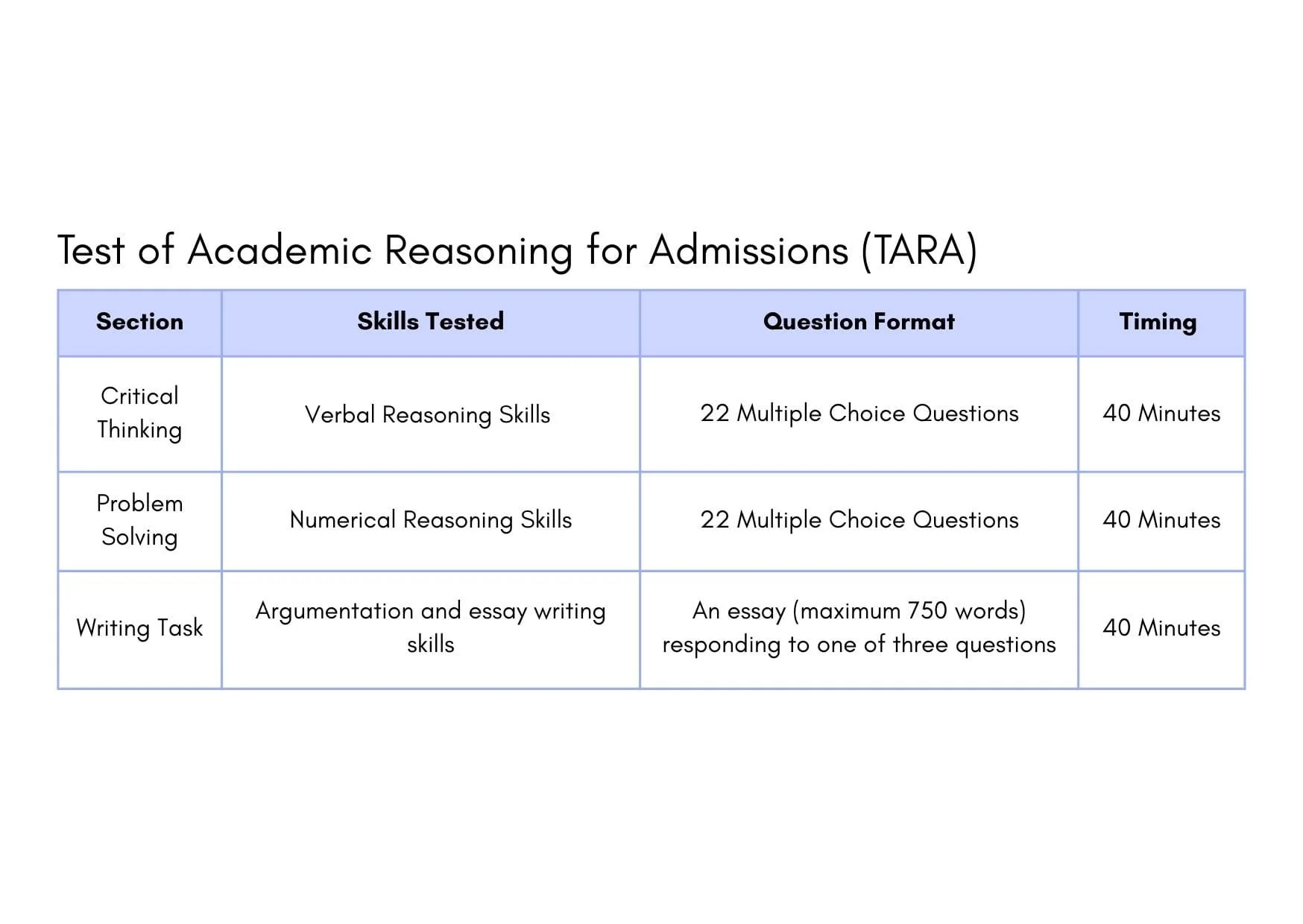
The TARA (Test of Academic Reasoning for Admissions)
TARA continues to assess the same underlying skills as the TSA, but with a new structure and some significant practical differences.
Key structural changes
Problem Solving and Critical Thinking are now separate sections, rather than interspersed.
There are fewer multiple-choice questions per section, with slightly less time overall.
22 per section as opposed to the TSA’s 25.
40 minutes rather than 45 minutes to attempt each section.
Marks are not deducted for incorrect answers, so candidates are encouraged to attempt all questions.
All candidates sit all three components:
Problem Solving
Critical Thinking
Writing Task
The Writing Task is longer (40 minutes) and now:
Has a maximum word count of 750 words
Mandatory for all TARA candidates
1. Critical Thinking (Verbal Reasoning)

This module assesses a student’s ability to understand, analyse and evaluate arguments expressed in everyday written language, a skill fundamental across the humanities, sciences and social sciences.
Students must:
Identify reasons, conclusions and assumptions
Draw logical conclusions from given information
Assess how new evidence strengthens or weakens an argument
Detect flaws or reasoning errors
Recognise parallel reasoning structures
Apply general principles to new situations
Crucially, conclusions may appear anywhere within a passage, and assumptions are often unstated. As a result, students must utilise careful reading and logical sensitivity rather than speed-reading or surface comprehension.
2. Problem Solving (Numerical Reasoning)

The Problem Solving module tests a student's ability to reason quantitatively in unfamiliar contexts, using only basic mathematical knowledge.
Questions test students' flexibility of thinking, not calculation speed.
Students must:
Select relevant information from distracting or redundant data
Devise and apply appropriate procedures where no obvious method is given
Identify patterns or similarities across tables, graphs, charts or spatial representations
The mathematical knowledge assumed remains accessible and non-technical, covering areas such as:
Basic number concepts and percentages
Every day, numerical operations
Time, money and measures
Simple area, perimeter and volume
Interpreting tables, charts and graphs
3. Writing Task (Academic Argumentation)
All TARA candidates complete a 40-minute writing task, choosing one question from a set of three.
This task assesses a student’s ability to:
Interpret an abstract or general statement
Construct a balanced, reasoned argument
Engage with counter-arguments thoughtfully
Express ideas clearly, concisely and coherently within a strict word limit (750 words)
The emphasis is on quality of reasoning and organisation, not specialist subject knowledge. Clarity of thought is crucial to success.
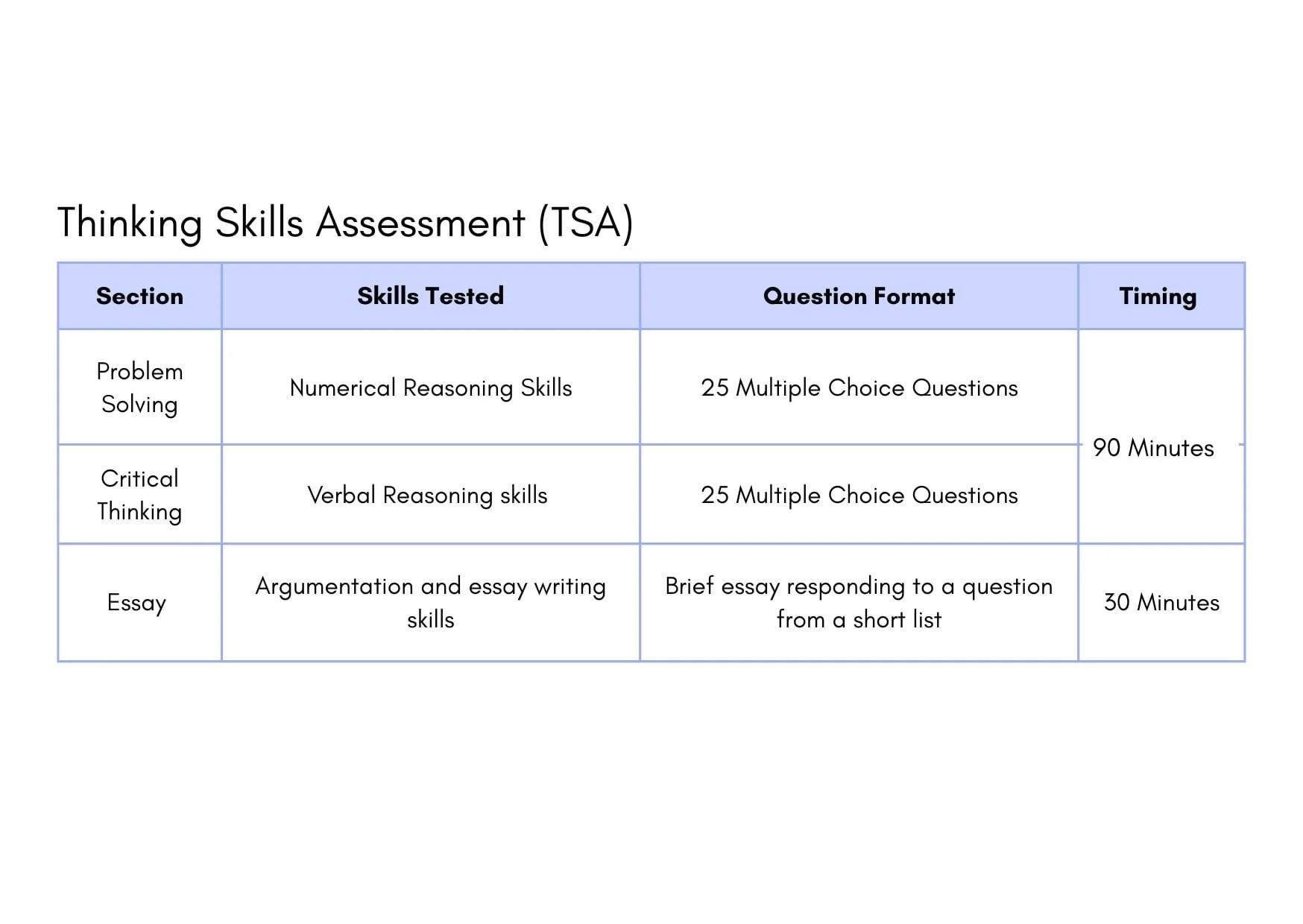
The TSA (formerly used by Oxford)
The TSA consisted of a multiple-choice section and an essay:
50 multiple-choice questions in total
25 on Problem Solving
25 on Critical Thinking
Questions from both areas were interspersed, rather than grouped by section.
Not all subjects that used the TSA required students to complete the essay section.
Problem Solving (Numerical Reasoning)
This section tested numerical reasoning using everyday data and required applicants to work with:
Number concepts
Numerical operations
Quantities and measures
Space and spatial reasoning
Tables, charts and graphs
Applicants were presented with diagrams, tables or graphs and asked to:
Select relevant information
Apply appropriate procedures
Identify patterns or similarities
Critical Thinking (Verbal Reasoning)
This section focused on reasoning using written language. Students were required to:
Identify reasons, conclusions and assumptions
Draw inferences
Evaluate options and make judgments
Question types included:
Identifying the main conclusion
Drawing a conclusion from evidence
Identifying assumptions
Assessing the impact of new information
Detecting reasoning flaws
Matching arguments
Applying general principles to specific cases
Essay Task (TSA)
Some applicants were also required to complete a 30-minute essay, choosing from a small set of prompts. This assessed a student’s ability to:
Understand a question quickly
Construct a coherent argument
Consider alternative viewpoints
Communicate clearly and persuasively under time pressure
Past essay prompts included broad, conceptually demanding questions such as:
Should convicted criminals be allowed to vote?
If gender imbalance in leadership worries us, should imbalance in school exclusions also worry us?
What do we lose when a language survives only in written form?
The key takeaway
While TARA replaces the TSA structurally, the underlying challenge remains the same: reasoning clearly in unfamiliar situations, under time pressure. Preparation is therefore most effective when it focuses on thinking processes rather than memorising question types.
TARA is not “easier” or “harder” than the TSA; it is different. Our tutors can help you develop robust reasoning processes that lead to TARA success. Contact us to begin your TARA journey.

How Should Students Prepare for the TARA Admissions Test?
The TARA admissions test bears no direct link to school syllabi. It's also deliberately tricky, as the UAT-UK website states:
"The UAT-UK tests are designed to be challenging. Our tests need to separate highly capable applicants clearly. This includes those who may have achieved top grades in school exams. Candidates should not expect to score as highly on these tests as they have in their school exams."
For many students, this is the first time they will encounter a test designed specifically to assess high-level academic reasoning, rather than curriculum mastery.
Success in TARA, therefore, depends less on content knowledge and more on clear reasoning, structured thinking, time management, and the ability to articulate arguments effectively under pressure. The test's nature is precisely why early preparation and familiarity with the test format and skills assessed are so necessary.
What effective TARA preparation looks like
TARA preparation is most effective when it is:
Skills-led, not syllabus-led
Informed by an initial diagnostic assessment
Supported by expert feedback on reasoning processes and written responses
Integrated into a broader Oxford admissions strategy, including personal statements, interviews and course fit
At U2 Tuition, our approach mirrors how Oxford uses the test:
We focus on how a student thinks, not just whether an answer is correct
We train transferable reasoning strategies across unfamiliar contexts
We provide structured feedback on written responses, aligned with admissions expectations
Experienced Oxbridge-educated tutors deliver all support

Official and recommended preparation resources
Students also have access to a range of useful official materials:
UAT-UK familiarisation materials (available after registration), including specimen tests to help students get used to the online format and navigation. These do not generate scores, but do provide answer feedback.
The official TARA Question Guide and the TARA Specification give detailed insight into question types and assessed skills.
Oxford TSA past papers, which remain helpful for developing closely related reasoning skills. Remember that these are not direct replicas of TARA questions, but are valuable resources. The same can be said of BMAT past papers, which are available on the UAT-UK website.
Our Oxbridge-educated tutors provide bespoke TARA preparation materials designed to build familiarity with the test, strengthen reasoning skills, and support confident, effective preparation.
Used strategically, these resources help students build confidence and fluency with the test style, but they are most effective when combined with guided analysis and feedback.
Next steps
If you’re applying to Oxford or UCL for a TARA-required course, early, strategic preparation is key.
U2 Tuition offers:
1-to-1 TARA diagnostics
Bespoke preparation programmes, including resources
Integrated admissions support (test, interview and application strategy)
All delivered by Oxbridge-educated tutors
U2 Tuition offers the highest calibre support for all UK University and Oxbridge Admissions Tests.
👉 Book a consultation to discuss TARA preparation tailored to your course and application profile.
TARA FAQs
What is the TARA admissions test?
The TARA, or Test of Academic Reasoning for Admissions, is a computer-based university admissions test designed to assess how applicants think, rather than their memorisation and knowledge retention abilities. It assesses critical thinking, problem-solving, information interpretation, and academic reasoning through multiple-choice questions and a brief written task.
Which Universities and courses use the TARA test?
UCL currently uses TARA for a range of courses, including Computer Science and social sciences. Oxford will adopt it from the 2027 entry, replacing the test component for undergraduate courses, which previously used the TSA: PPE, Human Sciences, and Psychology. Other universities may adopt it in future.
How do I register, and when do I need to sit the TARA test?
Registration will open via the UAT-UK website (typically in July), with tests delivered through Pearson test centres worldwide. There are currently two sitting windows for TARA each year, the first in October and the second in January. Oxford applicants will have to sit for one of the two October dates.
As with the ESAT and TMUA, applicants must pay the registration fee. This is £75 for students in the UK and the Republic of Ireland. It's £130 for students anywhere else. There is a bursary scheme for candidates who meet the eligibility criteria.
Applicants applying to multiple universities that use TARA only need to take the test once.
What skills does the TARA test assess?
TARA's design assesses academic reasoning skills, including logical and critical thinking; problem-solving in unfamiliar contexts; interpreting written and numerical information; evaluating arguments, and expressing ideas clearly in writing
It does not test subject-specific syllabus content, so generic revision and memorisation are redundant. Applicant must develop and practice the core skills.
What is the format and duration of the TARA admissions test?
TARA is an entirely computer-based test featuring 44 multiple-choice reasoning questions and a written task. It is taken at authorised Pearson test centres and lasts 2 hours total. Each module is 40 minutes long and separately timed. The emphasis is on reasoning under time pressure rather than technical knowledge.
How is the TARA test different from the TSA?
TARA replaces the TSA for several Oxford courses. It is similar in purpose, content and overall approach, with both tests assessing academic reasoning, critical thinking and problem-solving rather than subject knowledge.
However, TARA is a different test run by a different provider, and there are slight differences in areas such as test length, format, and specific question design. Applicants should not expect the questions themselves to be the same.
That said, much of the guidance and preparation developed for the TSA remains relevant, especially given that the skills observed are very similar, if not the same.
Support from experienced tutors who understand how these tests factor into admissions decisions and who stay up to date with changes can make a meaningful difference to students' preparation.
How should students prepare for the TARA admissions test?
Effective preparation focuses on developing reasoning processes, not memorising question types. This includes learning how to approach unfamiliar problems, practising logical decision-making under time pressure, and developing clarity and structure in written responses. Students are best supported when they receive feedback on their thinking, not just on accuracy.
TARA preparation works best when integrated into a student's wider admissions strategy.
Are there official past papers or sample questions for TARA?
As this is a newer test, introduced only for the 2026 entry admissions cycle, past paper resources are currently limited.
The UA-T website provides helpful resources. Oxford's TSA and the old BMAT past papers are also sound practice, though their structure and questions are not identical to those of the TARA test.
Adequate preparation focuses on transferable reasoning skills rather than rote question practice.
Is the TARA test harder than the TSA?
Not strictly. The TARA test is similar to the TSA in terms of duration, overall format and the skills assessed. In both cases, the challenge lies less in the difficulty of the individual questions than in reasoning clearly and managing time effectively.
What makes both tests demanding is answering unfamiliar questions accurately and efficiently within the time limit. Strong preparation, therefore, focuses on developing pace, confidence and clear reasoning rather than learning content.
Who offers the best preparation for the TARA admissions test?
Students benefit most from specialist providers with deep Oxbridge admissions insight, structured diagnostic-based support, and reasoning-focused teaching, rather than generic test prep.
Learn more about U2 Tuition's support through a complimentary 20-minute TARA consultation.
Do I need a tutor to prepare for the TARA test?
Not all students need a tutor, but many benefit from structured guidance and expert feedback, particularly given the test's reasoning-based nature. Support is most effective when it helps students refine their thinking, rather than simply practising questions in isolation.
Completing past or specimen papers is great for test familiarity, but a tutor can offer detailed feedback and development strategies to boost your performance.
How long should I prepare for the TARA admissions test?
There is no fixed preparation period, as this depends on a student's starting point and familiarity with reasoning-based admissions tests. Most students benefit from several months of light, consistent preparation, rather than intensive last-minute practice.
Because TARA assesses how students think under time pressure, adequate preparation focuses on gradually developing reasoning, confidence, resilience, and pacing. Starting early reduced the risk of unnecessary pressure close to the test date.
Is the TARA test multiple choice only?
No, it also includes a short written task.